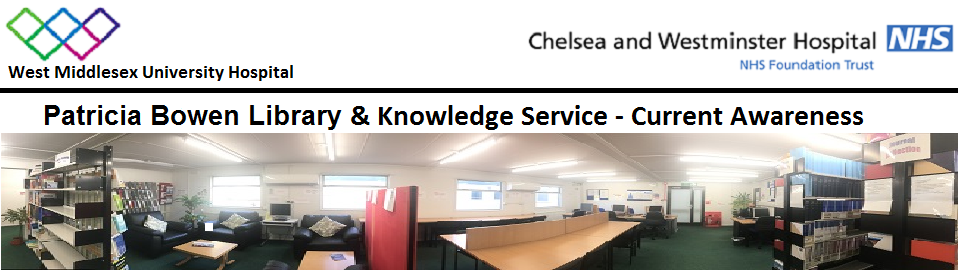
Some books available in the library
- A Guide to infection control in hospital
- Ayliffe’s control of healthcare-associated infection – a practical handbook
- Fundamentals of infection prevention and control theory and practice
- Hospital infection control / NHS executive
- Infection control: science, management and practice
- Infection prevention and control : theory and practice for healthcare professionals
- Manual of infection prevention and control
- Principles and practice of disinfection , preservation and sterilization
- Rapid infection control nursing
- Reducing healthcare associated infections
Search the Library Catalogue for Infection Control books
DynaMed – Infectious Diseases Topics (If you are not using Trust computer login with your OpenAthens)
Clinical Knowledge Summaries- Infections and Infestations Topics
Sepsis- Recognition and Management -Topic update
Recent articles from selected Journal RSS feeds/ News feeds
COVID-19 – Pubmed results
The paper builds on the classical understanding of the interplay between material processes and political conflicts, but generalises it in several key respects. This approach does not assume relevant political-economic aggregations ex ante (such as industries or 'classes'); rather, it explores different possible ways of aggregating social groups and defining their interests depending on the situation under investigation. Moreover, interdependencies in the economy impose the need to keep...
CONCLUSIONS: Further mitigation and suppression measures are necessary in the containment and sustained transmission phases, such as increased diagnostic capacity through testing and disinfection of populated areas and homes in isolation.
CONCLUSIONS: The identified spatial pattern may be influenced by the isolation measures taken at the local and national level, but the effect of the low access of the general population to diagnostic tests, delays and restraints to know the results cannot be ruled out and even possible biases due to difficulties in the technique of taking the sample or its conservation.
CONCLUSIONS: The cartographic representation derived from the implementation of a multicriteria model, integrated to a Geographical Information System, in the SARS-CoV-2 transmission risk analysis, constitutes a relevant methodological contribution for decision-making defining strategies of mitigation at the local level, facilitating the location and optimization of resources by the health authorities.
Many health workers in the Americas, especially women, have been victims of discrimination and different types of grievances during the COVID-19 pandemic. These brief reflections aim to make the problem visible, offer theoretical explanations and some recommendations. The pandemic constitutes a massive crisis that triggers fears and reassuring of diffuse anxieties, which often includes someone to blame. Healthcare workers have become circumstantial scapegoating targets. The inflicted attacks can...
CONCLUSIONS: There was prior knowledge that was strengthened by training and it was interpreted that health is a heritage that must be safeguarded with responsibility and biosecurity.
CONCLUSIONS: In the dental profession the potential risk of contamination among operators, assistants and patients is high. Knowing the causative agent and the disease allows you to reduce the possibility of contagion. The dentist must consider patients as suspects to COVID-19 and apply biosecurity at all levels.
Background: The COVID-19 pandemic relies on real-time polymerase chain reaction (qRT-PCR) for the detection of Severe Acute Respiratory Syndrome Coronavirus 2 (SARS-CoV-2), to facilitate roll-out of patient care and infection control measures. There are several qRT-PCR assays with little evidence on their comparability. We report alterations to the developers' recommendations to sustain the testing capability in a resource-limited setting. Methods: We used a SARS-CoV-2 positive control RNA...
Team projects and in-class interactions are the hallmark of a freshmen introductory course in biomedical engineering (BME). Our challenge was to continue team activities, mentoring, and the semester-long design project in a virtual environment after in-person classes ended due to the COVID-19 pandemic. This paper highlights some of the adaptations required to continue a large (n = 124) team-based course with students located throughout the world. Breaking up planned in-class activities into...
Face Masks
Across three studies, conducted between Spring 2020 and Spring 2021, we tested whether exposure to an Asian American/Pacific Islander (AAPI) target person wearing a face mask would increase or decrease White Americans' perceived threat from and positivity toward AAPI individuals. Although results varied by study, a single-paper meta-analysis revealed that the masked (compared to unmasked) AAPI target resulted in greater positivity toward AAPIs, due to reduced perceptions of both symbolic threat...
Madelung's disease (Launois-Bensaude syndrome) presents a critical challenge when managing acute respiratory failure (ARF) due to the high risk of difficult airway and failed intubation posed by symmetric cervical lipomatosis. This case series investigates the feasibility of non-invasive ventilation (NIV) as a primary strategy for ARF in these high-risk patients. We present two cases of severe ARF triggered by COVID-19 pneumonia in patients with Madelung's disease. Both patients were...
ABSTRACT: PURPOSE: To assess the reliability of standard automated perimetry in a real-life cohort of glaucoma patients and suspects wearing face masks due to the COVID-19 pandemic in a large German eye hospital.
CONCLUSION: Young people are self-conscious of their dental appearance, which impacts their peer relationships and can make them a target for teasing and bullying. Orthodontic treatment is considered normal, with peers and friends providing support.
The use of face mask compliance regarding compliance monitoring is important in health sensitive and surveillance driven environments. This paper has introduced a multi-class face mask compliance detection system in the form of a Deep Convolutional Neural Network (DCNN) and advanced MobileNetV3 model. The proposed system is also based on a more difficult three-class problem (correct mask use, improper mask use, and no mask) as opposed to the traditional binary mask detection methods. A balanced...
CONCLUSION: Proportion of people who reported poor sleep quality doubled in the pandemic. Optimizing sleep quality in crises among people who experience poor sleep quality should be prioritized when managing public health emergencies.
CONCLUSION: In sum, our study presents behavioral and neural evidence that personal familiarity with masked faces aids perceptual learning and eventual recognition, and this learning does not generalize to otherwise well-known faces.
The extensive use of single-use personal protective equipment (PPE) during the COVID-19 pandemic has substantially increased the generation of plastic-rich medical waste, raising concerns regarding its safe thermal treatment and bottom ash management. This study investigates the thermochemical behavior of commonly used PPE items, nitrile gloves, polypropylene gowns, and polypropylene face masks, analyzed individually and in blended mixtures representative of hospital practice. Thermal...
CONCLUSIONS: Perceived ability and readiness to practice social distancing emerge from interdependent social and structural conditions rather than isolated individual motivations. Public health responses to emerging infectious diseases may be more effective when individual-level guidance is complemented by accessible testing and treatment, supportive workplace policies, and community environments that visibly reinforce protective behaviors.
An 88-year-old man with a history of myocardial infarction, non-valvular atrial fibrillation and hypothyroidism was admitted to our hospital with a diagnosis of coronavirus disease. On admission, he had hypoxemia, with peripheral blood oxygen saturation at 95% on 5 L of oxygen via face mask ventilation. Chest computed tomography (CT) showed bronchial wall thickening and emphysema in both lungs, ground-glass opacities and high-attenuation areas in the bilateral lower lungs. After hospitalization...
Hospital Infection Control and Prevention (Full-text available via NHS Athens)
Journal of Hospital Infection (Full-text not available)
Infection Control
See also Patient Safety Update
If you have any comments/suggestions about this page or would like to add more feeds to this specialty please email us
 - Check what you can access with your account
![qrcode.14118297[1]](http://www.library.wmuh.nhs.uk/wp/wp-content/uploads/2013/06/qrcode.141182971.png)